
In another major achievement for the Department of Computer Engineering at Sharif University of Technology, Dr. Shayan Oveis Gharan, an alumnus of the department, has been awarded the 2026 Abacus Medal by the International Mathematical Union (IMU), joining the ranks of the world's most distinguished young researchers in theoretical computer science.
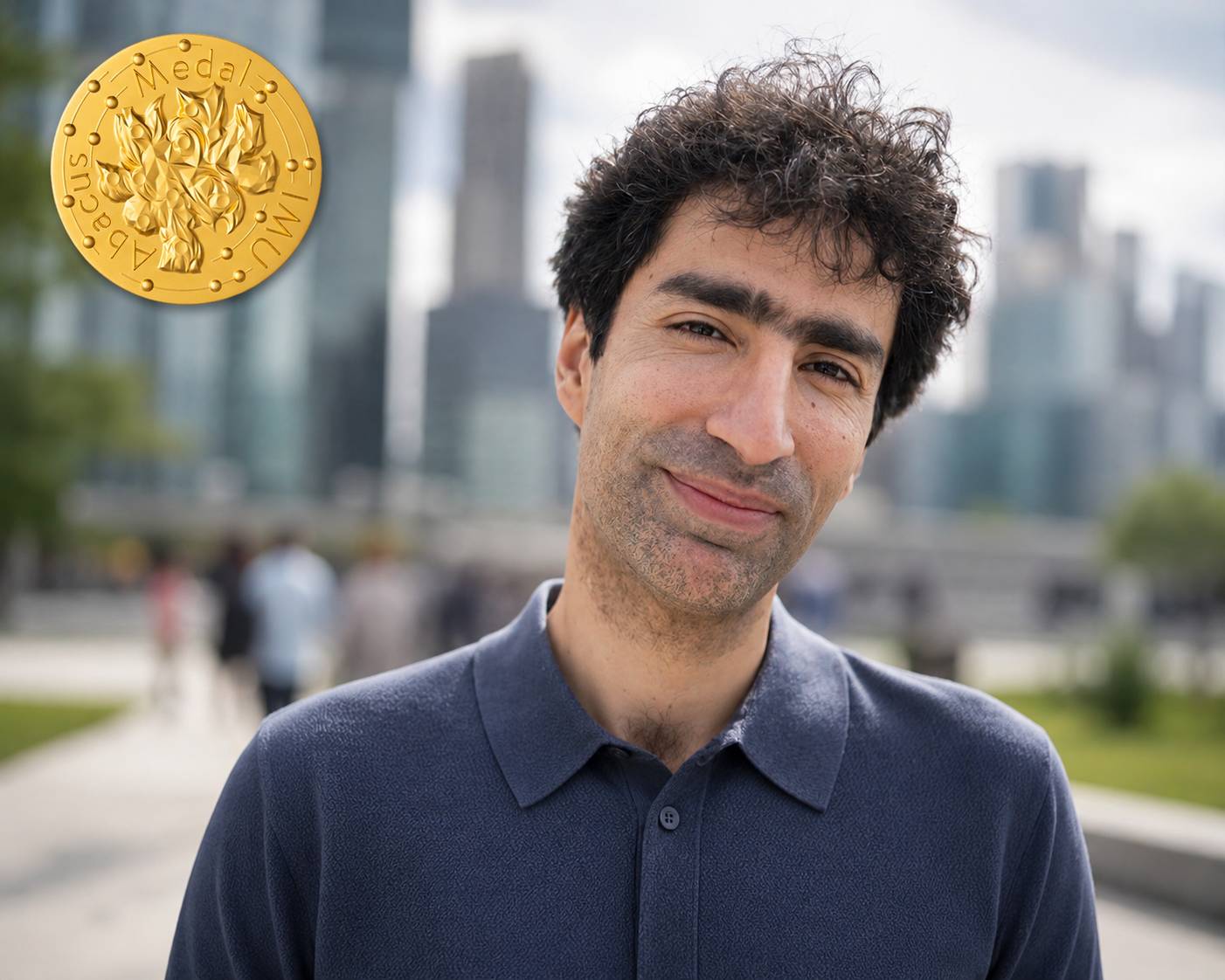
According to the Department of Computer Engineering at Sharif University of Technology, Dr. Shayan Oveis Gharan received the 2026 Abacus Medal during the International Congress of Mathematicians (ICM 2026), held in Philadelphia, United States. The Abacus Medal, presented by the International Mathematical Union (IMU), is one of the world's most prestigious honours in theoretical computer science.
Dr. Oveis Gharan completed his undergraduate studies at the Department of Computer Engineering, Sharif University of Technology before pursuing graduate studies at Stanford University, where he earned his Ph.D. in Computer Science in 2013 under the supervision of Dr. Amin Saberi, himself a Sharif alumnus. He is currently a Professor at the University of Washington. Earlier in his career, in 2004, he won a gold medal as a member of the Iranian national team at the International Olympiad in Informatics (IOI).
The Abacus Medal Committee recognised Dr. Oveis Gharan for his fundamental contributions to algorithms, graph theory, and theoretical computer science. His research has combined sophisticated mathematical techniques with algorithmic insights to advance the understanding of computational complexity and algorithm design, opening new directions in the analysis of algorithms beyond long-established frameworks.Among his most significant scientific achievements is his groundbreaking work on approximation algorithms for the Travelling Salesman Problem (TSP), one of the most fundamental optimisation problems in computer science. Together with his collaborators, he developed a novel algorithm that surpassed the performance guarantee of the classical Christofides algorithm, improving a bound that had remained unchanged for nearly five decades. This breakthrough is widely regarded as one of the most important advances in approximation algorithms in recent years.
His research has also made landmark contributions to Markov Chain Monte Carlo (MCMC) algorithms, the proof of the Mihail–Vazirani Conjecture, and the strongest known proven version of the Mason Conjecture through the concept of spectral independence. These achievements were specifically highlighted by the Abacus Medal Committee as exemplary examples of his scientific impact.
The Abacus Medal is awarded every four years to an outstanding young scientist for transformational contributions to theoretical computer science. It is regarded as the highest international distinction for young researchers in the field and succeeds the former Nevanlinna Prize.
International Mathematical Union's Report on the Award